Driveways & Patios
Stamped Concrete vs Plain Concrete vs Pavers for Lakeland Driveways and Patios
A Lakeland driveway or patio is usually a broom-finish slab, that same slab with a stamp pressed into it, or pavers on a sand bed. They can look alike from the street the week they go in. They do not age the same way after a Polk County summer and a few afternoon storms. Pick the one that matches how you will use the space.
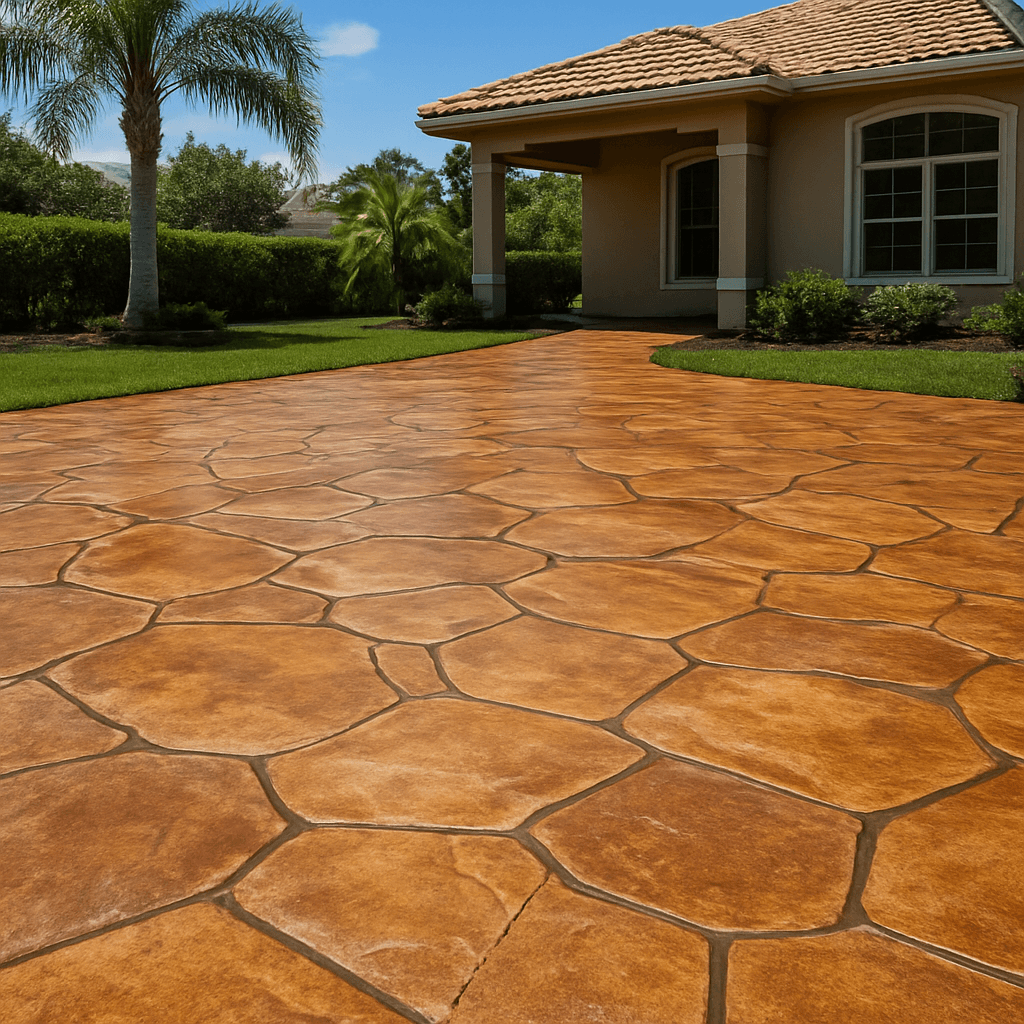
A stone-pattern stamp. The color is a surface treatment on one continuous slab, which is why the sealer is part of the finish.
What this guide covers
What you are actually buying
A broom finish is plain concrete with a stiff broom dragged across it while it is still soft. The ridges are the grip. Gray is the default. Integral color can change the look without turning it into a stamp. This is the ordinary concrete driveway and patio on most streets south of downtown Lakeland and out through the newer subdivisions.
Stamped concrete is that same pour. While the surface is still plastic, the crew broadcasts color, presses mats that mimic stone, brick, or wood, then washes off a release powder and seals it. The joints in the pattern are mostly fake. The real control joints are saw cuts, and those are the lines the slab is allowed to crack on. A rushed stamp smears, and you cannot broom it back.
Concrete pavers are precast units. Color runs through the unit instead of sitting in a film on top. They go down on a compacted base and a sand bed, with joint sand swept in and an edge restraint so the field does not spread. There is no cure day. You also inherit every joint. If a stamp is the option you want, settle the pattern before the truck is on the street. What to settle before you stamp a driveway is the short list. You do not get a second pass.
Look, and what a buyer actually notices
From the curb, a fresh stamp or a paver field reads as an upgrade. A broom driveway reads as a driveway. On a typical Lakeland ranch with a tile roof, a straight gray slab with clean joints looks finished. A faded stamp with the color gone in the wheel paths looks like a project that got tired.
Up close, a stamp repeats. Once you see the mat, you see it in every stone. Pavers have real gaps and color through the unit. A broom finish is gray, or a quiet integral color, with the same texture across the panel.
For resale, failure is what hurts: a lip at the sidewalk, color gone in the tire tracks, pavers that rock. A tidy broom driveway does not lower a house. A decorative surface that is kept up can help the front. Do not let anyone quote you a percent of the sale price for the product name. Buyers notice whether the hardscape is even.
Florida heat, heavy rain, and sandy soil
The ground is the same under all three
Polk County sand does not care which finish you picked. Loose sand, a buried bed, a muck pocket, or a root left in the cut will settle. A slab cracks over the soft spot. Pavers sink one unit at a time until the field dips toward the garage. Sandy soil and base prep is the part of the quote to read first: what gets dug out, whether they compact in layers, and where the rain goes.
Pavers are less forgiving of a thin base than people expect, because nothing is bridging the soft spot. A slab can hide a small void until it cracks. A paver sinks and announces it. Skipping compaction to save a day is the callback after the first wet summer, on a gray slab, a stamp, or a paver field.
Heat on pour day
Concrete stiffens faster on a Lakeland summer morning. A broom finish has a little room: place, strike, broom. A stamp has a short window. Too wet and the mat smears. Too far along and the mat will not take. That is why stamped pours start early, and why a complicated pattern on a big driveway is a different job than a small patio. Pouring in Florida heat and rain covers that clock. Pavers skip the cure. They do not skip a storm that hits while the bedding sand is still open.
Rain after the job is done
From late spring into fall the pattern is a hot morning and a storm after lunch. Water finds an open joint and carries sand out. On a slab that is a dropped corner by the lawn. On pavers it is an empty joint and a unit that clicks. A downspout or a sprinkler aimed at the new edge will do it to a job that looked perfect the day it was finished. Why Lakeland driveways crack covers washout versus a crack that is only cosmetic.
Under cars, a broom slab at a normal driveway thickness is the durable, boring choice. A stamp is the same concrete, so the slab lasts the same way if thickness, joints, and base are right. What ages is the color on top. Pavers last when the base is deep and the edge restraint is real. They fail by settling and spreading, not by one crack across a panel.
Sealing, heat underfoot, and how a repair goes
Maintenance is not the same job
A broom driveway can go years with a wash and a look at the joints. If you seal it, a penetrating sealer is the usual fit: it does not leave a film, so it does not peel, and it does not make the broom texture slick. Our Lakeland sealing guide splits penetrating sealers from the acrylic film used on colored work.
Stamped concrete wants that film. The color lives at the surface, and the sun fades whatever is left bare. The stamped driveway maintenance rules on this site plan a recoat every two to three years. If water beads, the sealer is still working. If it soaks in, it is time. Hot tires print a fresh acrylic coat, so stay off it for the days the crew asks.
Pavers do not have a color film to save. A glossy sealer on a driveway is optional and often a mistake. The recurring work is the joints. Sand washes out, weeds find the gaps, and ants in a Polk County yard will mine a joint and leave a little pile of sand on top. Budget time to sweep joints, not a reseal calendar.
Bare feet, pools, and a July afternoon
All three get hot. A dark stamp and a dark paver are the ones you hop across in the afternoon. A light broom finish is usually the kindest underfoot. None of them is cool in August. If the space is a pool deck, pick the lighter color on purpose.
Slip is separate from heat. A broom finish has the grip in the concrete. A high-gloss sealer on a stamp can be slick the first time it is wet, which is a bad walk from the house to the pool. Ask for a slip-resistant additive, and look at a sample wet. Smooth pavers can be slick too. Textured pavers grip better and still collect algae in the joints. A worn deck is pool deck resurfacing, not automatically a new stamp. Stamped pool decks in Lakeland covers what to ask about traction.
When something breaks
A hairline in a broom slab, both sides still level, is often shrinkage. Watch it. A lip, a rocking panel, or sand pumping out after rain means look at the base before anyone fills the line. If the slab is sound and only the surface is ugly, resurfacing can put a new wear layer on a broom finish. It will not make a failed base solid.
A stamp is harder to hide. A patch does not continue the stone pattern, and new color next to a sealer with two summers on it will not match. Replacing a panel means a saw cut, a new pour, and a stamp that has to meet the old one. Sometimes the honest move is to resurface and stop trying to sew the pattern back together.
Pavers win this part, with a condition. One cracked unit comes out, the bedding gets leveled, and the unit goes back. That matters if you expect to dig later for a drain or an irrigation line. If the whole field settled because the sand was never compacted, lifting three units does not fix the yard. You are rebuilding the base.
Typical cost ranges, with the caveats in the open
These are the typical installed ranges already used on this site for Lakeland-area planning. They are not a survey, and they are not a quote. Size, tear-out of the old driveway, how soft the yard is, the pattern or the paver you pick, permits, and the contractor all move the number. A small job often costs more per square foot because the crew and the truck still have to show up.
| Surface | Typical installed range | Example already on this site |
|---|---|---|
| Broom-finish driveway | $8 to $18 / sq ft | About $4,800 to $10,800 for a 600 sq ft two-car driveway |
| Plain concrete patio | $8 to $20 / sq ft | About $2,400 to $6,000 for 300 sq ft |
| Stamped concrete | $15 to $28 / sq ft | About $6,000 to $11,200 for 400 sq ft |
| Concrete pavers | $14 to $30 / sq ft | About $4,200 to $9,000 for a 300 sq ft patio |
The driveway figures are the same ones in how much a concrete driveway costs in Florida. Multiply a per-foot range by your square footage for a planning band, then set it aside when the quote includes tear-out, a new base, or a border. Premium pavers can sit above $14 to $30. Do not average three bids that describe three different holes in the ground.
Sealing is a separate line on stamped work. Our stamped cost notes use about $1 to $3 per square foot as a planning range for a recoat every two to three years. That is maintenance, not part of the pour. Ask which sealer is in the price, and whether the first coat is included.
Permits are not a finish. A new driveway inside Lakeland, and the apron in the right-of-way, is not the same paperwork as a backyard patio, and pavers that touch the street can have their own form. Driveway, patio, and slab permits in Lakeland and Polk County links the city and county pages. Ask, in the quote, who pulls it.
Which one fits the job
- Daily parking, and you want the least ongoing work. Broom-finish concrete. Spend the money under the slab, on thickness if a truck or a boat lives there, and on joints. Color is optional. A sealer is optional.
- A patio or front walk where the look matters, and you will reseal it. Stamped concrete. Keep the pattern simple and put the recoat on a calendar. A stamped driveway is a poor choice if you wanted the look of stone and did not want the sealer.
- You expect to lift a section later, or you want a repair that does not show a patch. Pavers, with a base you would trust under a slab. The units are the easy part. The compacted base and the edge restraint are the job.
- A pool deck. Broom or another textured finish, in a light color. Stamped only with a sealer that stays grippy when wet. Skip a high-gloss film on the walking surface. Pavers if you want to pull them up around equipment, and only if the texture is not a skating rink after a splash.
Two prices that are far apart are often two different scopes. One includes tear-out and a compacted base. The other pours on whatever is left after the grass is scraped. Match the line items before you match the finish.
Frequently Asked Questions
Is stamped concrete stronger than a broom finish?
No. The stamp is a texture pressed into the same concrete. Strength comes from the mix, the thickness, the joints, and the ground under it. A thin stamp on loose sand cracks the same way a plain slab does.
Which surface is least slippery by a pool?
A broom finish has texture in the concrete itself, so it is usually the most predictable when wet. Stamped concrete with a glossy sealer can be slick. Ask for a slip-resistant additive if the stamp is a pool deck or a walk to the water. Pavers depend on the unit: a smooth face is slicker than a textured one.
Can I patch stamped concrete so the pattern matches?
A small chip can be colored, and it will still read as a repair up close. A crack through the pattern does not disappear. Replacing the panel, or resurfacing a sound slab, is the honest fix. Pavers are the surface you can lift one unit at a time.
Do pavers need less maintenance than stamped concrete?
They need different maintenance. Stamped concrete needs a film sealer on a schedule so the color survives the sun. Pavers need joint sand, and in Polk County that sand washes out. Neither one stays looking new if you ignore it.
Which one costs less in Lakeland?
A broom-finish slab is the low end of the ranges published on this site: about $8 to $18 per square foot for a driveway and $8 to $20 for a patio. Stamped concrete is listed at $15 to $28 per square foot. Concrete pavers are listed at $14 to $30. Tear-out, a soft yard, a border, and the crew all move the real price. Get quotes.
Keep Reading
Ready to price a driveway or patio in Lakeland?
Tell us the size, whether cars will park on it, and whether you want a broom finish, a stamp, or pavers. We pass the request to a local crew. Ask, in the quote, what they dig out, how they compact it, and who pulls the permit.