Base & Subgrade
Sandy Soil and Base Prep for a Concrete Driveway in Lakeland and Polk County
A summer storm in Lakeland does not only wet a new driveway. It tests whatever is under it. A lot of Polk County is sand, and sand can carry a slab once it is clean and packed. Loose sand, a buried flower bed, a muck pocket, or a root left in the cut will not. The crack usually shows up after the first wet summer, and by then the concrete is the expensive part.
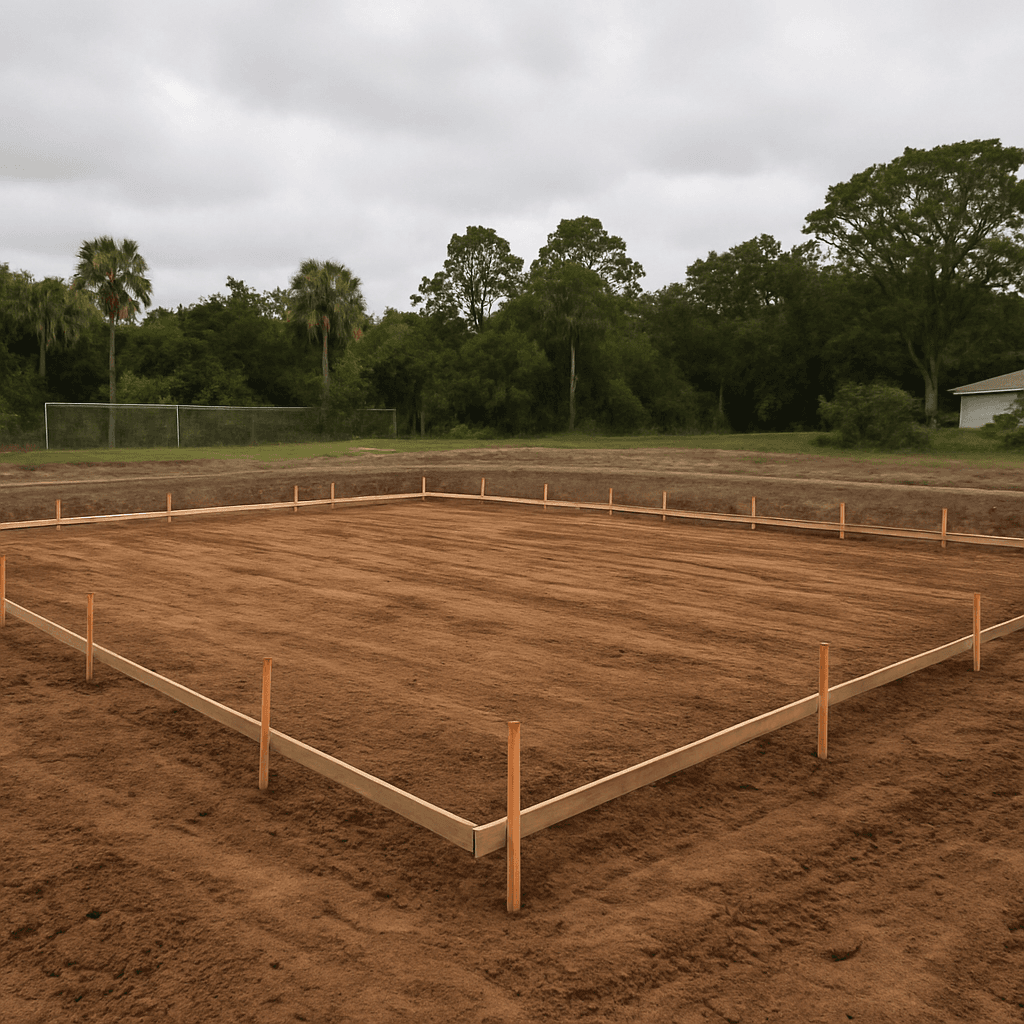
Forms on a graded pad. The slab lasts only if the ground under those boards was cleared, compacted, and given a way to drain.
What this guide covers
Why the ground under a Polk County slab is the job
Lakeland is not one soil. Some lots are deep, dry sand. Yards closer to the lakes, and a lot of the flatter ground elsewhere in the county, can hold water closer to the surface. The same prep questions apply to a concrete driveway, a patio, and a shed or equipment slab. The load on top changes. The ground does not forgive a shortcut.
Sand that was never packed
Packed, clean sand drains and can carry a residential slab. Loose sand moves. The first time it is soaked, it settles, and the concrete cracks where it was bridging the soft spot. Extra inches of concrete do not fix that. Why Lakeland driveways crack starts with this, because it is the usual cause, ahead of a bad mix.
Water that sits close
Near Lake Hollingsworth, Lake Parker, and low yards away from the ridge, a shallow cut can be dry on a March afternoon and damp by the time a crew finishes digging in August. That is groundwater or a buried low spot. Pouring onto mud, or onto sand that is pumping water, leaves the slab with nothing firm under it. If the pad will not stay firm, the practical move is to raise the work on compacted fill and give rain a path that is not the house footing.
Summer rain after the slab is hard
From late spring into fall, the county's pattern is a hot morning and a storm after lunch. On pour day that storm can wreck concrete that has not set. Pouring in Florida heat and rain covers that clock. After the slab is hard, the same storms run along the edge, find an open joint, and carry sand out. A dropped corner next to the lawn is often that washout. A downspout dumping on the new edge, or a sprinkler aimed at the same joint every morning, will do it to a pour that looked fine the day it was finished. Winter Haven and Bartow get the same storms.
Organic pockets and muck
Pale sand is the ordinary cut. A dark, soft pocket is usually topsoil, a filled low spot, or muck. Organics rot and compress. Sod flipped upside down, a stump left in the cut, or a flower bed buried under "a little extra dirt" becomes a void. Concrete does not span that void for long. A typical driveway cut on the south side of Lakeland: pale sand across most of it, and one dark pocket by the garage where a bed used to sit. That pocket is the corner that drops after a wet summer. Dig it out to the same clean material as the rest, then put fill back in layers.
The USDA Web Soil Survey will show the map unit for an address. It will not show what a previous owner buried. The hole tells you that.
Tree roots
Older streets in Lakeland, Winter Haven, and Bartow are full of oaks. A live root under a driveway thickens and lifts a panel. A root that is cut and left in the ground can rot into a hole. Roots in the pour area come out. A large tree tight against the cut is a conversation before anyone prices the job. Taking a major root can hurt the tree. Leaving it schedules a lip in the concrete.
Sinkholes, the uncommon cause
Polk County has sinkhole geology. Most soft spots under a driveway are still poor fill, buried organics, or sand that was never compacted. A sinkhole is the one you do not guess about. A sudden round low spot, new cracks in the block, or doors that started sticking in the same week are reasons to stop. Read the sinkhole signs worth a second look before anyone pours over the dip. A thicker slab will not close a void under the yard.
What proper prep looks like
Clearing
The pour area comes down to bare ground. Sod, roots, stumps, landscaping timbers, and the old driveway or patio come out and get hauled off. Do not spread the spoil back into the subgrade. Have utilities located before the first bucket goes in. A buried irrigation line or a yard-light cable is an expensive surprise in a shallow cut.
Removing organics
Topsoil and muck do not belong under concrete. Scrape to clean sand or to firm native soil, including under the edges, not only in the middle. If a soft spot is deeper than the rest of the pad, dig that pocket out and replace it. Do not bridge it with a thicker slab and hope.
Compaction
Compact the bottom of the excavation. If fill is going back in, compact it in layers thin enough that the machine actually densifies each one. On a driveway, a plate compactor is the usual tool. Deeper fill needs something heavier. Driving a loaded truck across loose sand once is not compaction. Walk the pad. Your shoe should not punch in. A larger job may come with a density target from an engineer. On a house driveway, ask what they compacted, in what layers, and with which machine.
Base material
Firm, clean sand can carry a patio, a shed pad, or a car driveway. That is not the same as pouring on whatever is left after the sod is scraped. Where the ground was disturbed, stays wet, or will see a heavier vehicle, crews around here often place limerock or crushed concrete and compact that layer. Ask what they are bringing in, how thick it is, and why this lot needs it. Rock dumped loose on muck is still a pour on muck. A sprinkle of gravel that mostly shows up in photos is not a base.
Grading and drainage
Water has to leave. A driveway that pitches back toward the garage, or a patio with a birdbath in the middle, sits wet every summer and starts washing sand out at the joints. Crews often aim for a fall you can see away from the house, on the order of a quarter inch per foot for the first stretch off the wall. Treat that as field practice, not a line from the Lakeland code. The test is after a storm: no pond on the slab, and no pond against the house.
Extend downspouts past the new edge. At the street, the apron has to meet the gutter the way the city or the county wants. Inside Lakeland, that right-of-way work is its own review. The Lakeland and Polk County permit guide covers which office has the lot, including unincorporated county.
Forms
Forms hold the wet concrete to the line and the height you agreed on. On sand they need enough stakes that the boards do not bow when the concrete pushes. A wavy form is a wavy edge. Before the truck is on the street, the high side should be the house side, and a driveway should fall toward the street rather than toward the garage door.
Reinforcement, then the pour
Wire mesh or rebar helps hold a crack together so it does not become a step. It does not carry a slab across a soft spot. Mesh lying on the sand is under the concrete, not in it. It needs chairs or other supports so it stays up while people walk the pour. Fiber mixed in at the plant helps with small shrinkage cracks. It is not structural steel, and it does not replace control joints.
Thickness is the other half. A typical car driveway is about 4 inches. A work truck, an RV, or a boat that sits in one spot is a different slab. How thick a Florida slab needs to be covers that. Under an enclosed garage or shop floor, a vapor barrier is common so moisture does not come up through the slab. An outdoor driveway usually needs to drain, not sit on plastic that traps water. Ask which one is in the price.
Dry sand will pull water out of the mix, so the subgrade should be damp, with no puddles in the forms, before concrete hits it. Joints are cut so the crack follows a straight line. On a typical 4-inch pour, crews often space them about 8 to 12 feet apart and keep panels closer to square than to a long strip. That spacing is a field habit, not an ordinance.
Questions to ask before you hire
You are not running the prep. You are checking that the quote describes it. Two prices that look far apart are often two different holes in the ground.
- What comes out of the ground? How deep do they dig, and what do they do if they hit a dark pocket or water?
- Compaction. Will they compact in layers, and with what machine?
- Native sand or hauled-in base? What material, how thick, and why this lot needs it.
- Where the rain goes. Slope, downspouts, and whether the yard currently holds water against the house.
- Joints. Where the control joints will be, and whether they are cut the day of the pour in summer.
- Steel. What mesh or rebar is in the price, and how it stays up during the pour.
- The permit. Who pulls it, including the apron if the concrete touches the street.
- A storm on the schedule. What happens if the forecast is a summer afternoon thunderstorm.
Red flags in the quote, or on pour day
- "It is sand, we just pour on it," with no plan to strip organics or compact.
- Sod, roots, or chunks of the old driveway left in the cut and covered.
- Fill dumped the morning of the pour and raked smooth, with no compactor on the job.
- Standing water in the forms, and concrete going in anyway.
- Mesh still bundled on the lawn when the truck arrives, or mesh already flat on the sand with nothing holding it up.
- Forms that bow, or a slope that falls back toward the house.
- "Fiber means it will not crack." All concrete can crack. Joints and a firm base decide where.
- A fresh round dip in the yard waved off as ordinary settling, with nobody willing to look harder.
- A low price that skips the base, then a change order once the old slab is gone and the muck is visible. The scope should say what happens when the ground is worse than it looked.
If the slab is already down and an edge has dropped, that is concrete repair, after someone has looked at the base. Filling the line and leaving the washout alone sets up the same drop next summer.
Frequently Asked Questions
Can you pour a concrete driveway straight on Florida sand?
Clean sand that has been stripped of topsoil and compacted can carry a residential driveway, patio, or shed slab. Loose sand, buried sod, or a muck pocket cannot. Pouring on whatever is left after the grass is scraped is not the same thing as pouring on a prepared subgrade.
What is the difference between subgrade and base?
The subgrade is the native soil under the job, after organics are removed and the ground is compacted. The base is material brought in on top of that, often limerock or crushed concrete in this part of Florida, then compacted. Some firm sand lots do not need a hauled-in base. Disturbed or wet ground usually does. Ask which one your quote includes.
Does every patio need a layer of limerock?
No. A patio on firm, clean, compacted sand can be poured on that sand. Limerock or crushed concrete earns its place when the ground was dug up, stays wet, or has soft spots. A thin sprinkle of gravel over muck does not fix the muck.
Will rebar or fiber stop cracks if the soil is soft?
No. Steel and mesh help keep a crack from opening into a step. Fiber helps with small shrinkage cracks. None of them hold a slab up across a void or loose fill. The ground has to be firm first. Joints still tell the slab where it is allowed to crack.
How do I tell a soft spot from a sinkhole?
Most soft spots under Polk County flatwork are poor fill, buried organics, or sand that was never compacted. A sinkhole is less common and not something to guess about. Stop and get it looked at if the low area is sudden and round, or if the house is cracking and doors are sticking in the same stretch of time. Do not pour over that dip and call it compacted.
Keep Reading
Planning a driveway, patio, or slab on Polk County sand?
Tell us the size, what will sit or drive on it, and whether the yard holds water after a storm. We pass the request to a local crew. Ask, in the quote, what they dig out and how they compact it before the truck is scheduled.