Concrete Explainer
What Is Concrete Pool Deck Resurfacing?
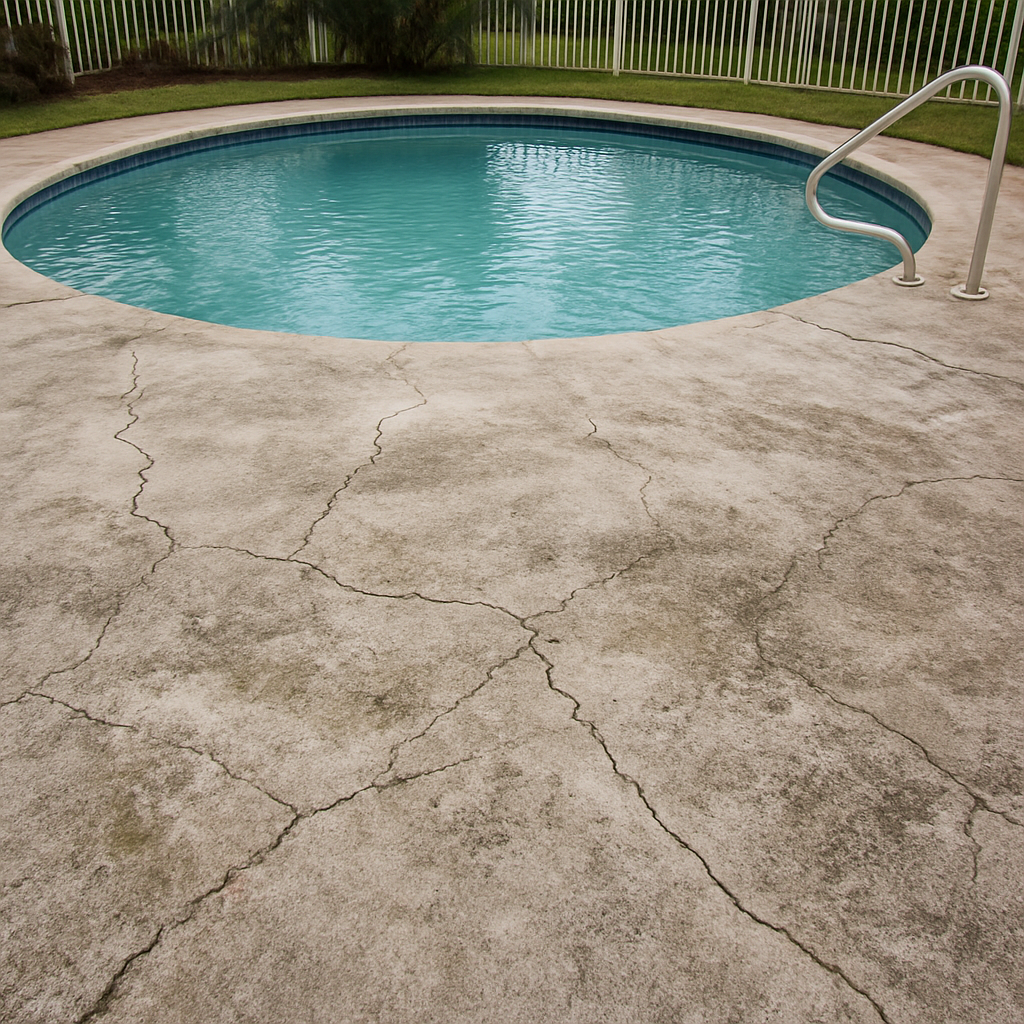
A worn but structurally sound deck — the ideal resurfacing candidate.
The Short Definition
Concrete pool deck resurfacing is the process of applying a new wearing surface over an existing concrete deck rather than tearing it out and pouring a new one. The structural slab is left in place. A coating or a cement-based overlay is bonded to it, renewing the texture, color, slip resistance, and protection.
Because the slab stays, you skip demolition, haul-away, forming, and a new pour — the four things that make replacement expensive. That is the entire value proposition, and it is also the source of resurfacing's one hard limit: it is a surface treatment. It renews what you walk on. It does not repair what the slab is sitting on.
How The Process Works, Step By Step
Most residential pool decks take two to four days from start to finish. The order rarely varies much between contractors.
Inspection and crack assessment
The contractor checks whether the slab is structurally sound and identifies what kind of cracking is present. Hairline shrinkage cracks are cosmetic and can be filled and covered. Cracks with vertical displacement — one side sitting higher than the other — indicate settlement underneath, which resurfacing will not solve and which has to be addressed separately first.
Deep cleaning and surface prep
The deck is pressure washed and, depending on the system, mechanically ground or acid-etched to open up the concrete pores. This step is what the bond depends on. An overlay applied over a sealed, dirty, or glazed surface will delaminate no matter how good the material is — prep failures are the most common reason a resurfacing job fails early.
Repairs and patching
Existing cracks are cleaned out and filled, spalled areas are patched, and any low spots that hold water get leveled. Control joints are honored rather than covered over — they exist to let the slab move, and an overlay bridged across a joint will simply crack along that line.
Primer or bond coat
Most systems require a bonding agent or primer so the new layer chemically grips the old slab. This is also where a moisture issue would surface: if vapor is moving up through the slab, a non-breathable coating will blister later, so a moisture test may be run first.
Applying the new surface
The chosen system goes down — sprayed acrylic, a knockdown texture overlay, a stamped overlay, or a resin coating with broadcast aggregate. This is usually one to two days depending on the system and how many coats it requires.
Sealing and cure
A sealer protects color and adds stain resistance, and on smooth finishes a grit additive is mixed into the sealer for slip resistance. Most decks accept foot traffic within about 24 hours of the final coat, though contractors typically ask you to keep furniture off and stay out of the pool for a few days.
Is Your Deck A Candidate?
This is the question worth answering honestly before you spend anything. Resurfacing a deck with an unresolved structural problem means paying twice — once for the overlay, and again when the same crack reappears through it.
Good candidate
- Surface is worn, faded, chalky, or stained but the slab is solid
- Hairline or shrinkage cracks with no height difference across them
- Surface texture has worn smooth and slippery over the years
- You want to change the color or pattern without replacing the deck
- Minor spalling or pitting confined to the top surface
Fix the slab first
- Slab sections have settled and no longer sit level with each other
- Cracks are wide, actively growing, or have a step across them
- Deck is lifting, rocking, or sounds hollow when tapped
- Water pools badly enough that drainage needs re-grading
- Previous coatings are delaminating across large areas
If your deck falls in the right-hand column, that usually means slab leveling or structural repair first, then resurfacing afterward.
What To Read Next
Once you know your deck is a candidate, the next two decisions are which surface system to use and what to budget. We cover the systems in What Are The Different Types Of Pool Deck Resurfacing? and the numbers in How Much Should It Cost To Resurface A Pool Deck In Lakeland Florida? If you already know what you want and just need someone to do it, the Lakeland provider list is the place to start.
Pool Deck Costs, Contractors & Guides
See local pricing, compare contractors on the map, or read the full service overview.
More On Pool Deck Resurfacing
The rest of our pool deck guides — costs, surface types, and local providers.
Pool Deck Resurfacing In Lakeland Florida
Local providers, what the work involves, and what it costs around Lakeland.
What Are The Different Types Of Pool Deck Resurfacing?
Acrylic cool deck, knockdown, stamped overlay, pavers, and resin coatings compared.
How Much Should It Cost To Resurface A Pool Deck In Lakeland Florida?
Per-square-foot pricing, deck-size estimates, and what moves the number.
Epoxy Pool Deck Resurfacing
Where epoxy genuinely fits outdoors — and the UV-stable systems used instead.
5 Pool Deck Renovation Ideas For Your Home
Practical ways to update a tired deck without tearing out the slab.
Frequently Asked Questions
What is concrete pool deck resurfacing?+
It is the process of bonding a new wearing surface — either a coating or a cement-based overlay — to an existing concrete pool deck, instead of demolishing and repouring the slab. The structural slab stays in place and everything above it is renewed: texture, color, slip resistance, and sealer.
How is resurfacing different from replacing a pool deck?+
Replacement means breaking out the old slab, hauling it away, re-forming, and pouring new concrete. Resurfacing reuses the existing slab entirely. That makes resurfacing far cheaper and faster, but it also means resurfacing cannot fix a structural problem — it renews the surface, not the foundation under it.
How thick is a pool deck resurfacing layer?+
It varies by system. Acrylic coatings and micro-toppings are very thin, often under an eighth of an inch. Knockdown and stamped overlays are thicker but still measured in fractions of an inch. Because build height is low, resurfacing rarely affects coping heights or door thresholds — one of its practical advantages over laying pavers on top.
Will resurfacing make my pool deck less slippery?+
It can, and that is one of the most common reasons people do it. A worn deck loses its original texture and gets slick when wet. A knockdown or textured acrylic system restores real grip. Smooth finishes like micro-toppings are the exception — those need a grit additive in the sealer, or they can end up more slippery than what you started with.
Does resurfacing help with heat on a Florida pool deck?+
Yes, if you pick the right color and system. Light-colored acrylic cool deck coatings are specifically formulated to stay cooler underfoot than bare gray concrete. Dark colors and dark stamped overlays absorb more heat, which is a real consideration on a deck people walk on barefoot in July.
How much does it cost to resurface a concrete pool deck?+
In the Lakeland area, pool deck resurfacing generally runs $4 to $12 per square foot installed depending on the system chosen. A standard 400-square-foot residential deck typically lands between $1,600 and $4,800.
Get a Free Pool Deck Quote
Submit a free quote request and we'll connect you with a Lakeland contractor who resurfaces pool decks — no waiting on a callback.