Design Ideas
5 Pool Deck Renovation Ideas For Your Home
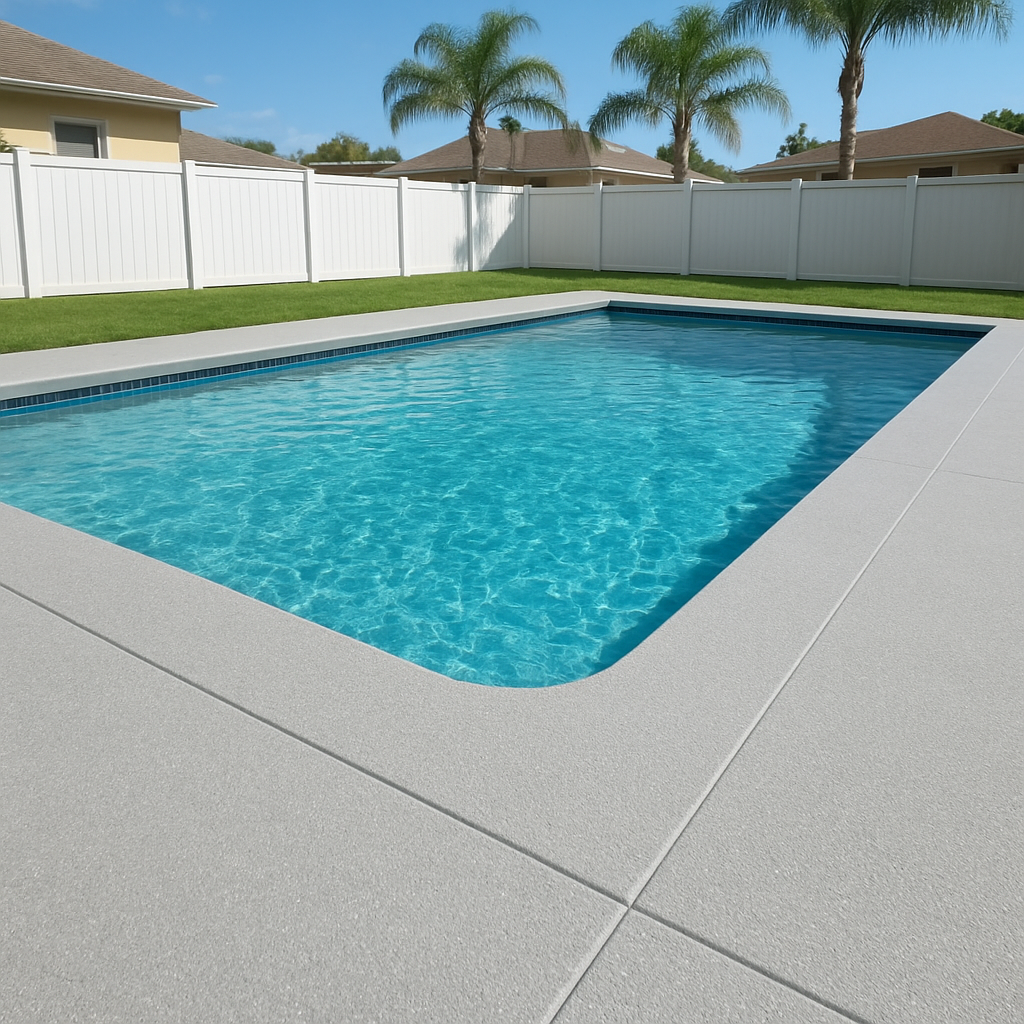
Most pool deck renovations reuse the existing slab entirely.
Start By Checking The Slab
Every idea below assumes the concrete underneath is structurally sound — no settled sections, no cracks with a height difference across them, nothing lifting or sounding hollow. Those are signs of a problem that has to be fixed before any new surface goes on, because it will telegraph straight through. If you're not sure which category your deck falls into, this guide walks through how to tell.
Swap bare concrete for a cool deck texture
What it is: A light-colored textured acrylic coating sprayed over the existing slab. This is the most common pool deck surface in Central Florida and the least expensive way to transform how a deck looks and feels.
It solves the two problems bare gray concrete has around a pool: it stays cooler underfoot than an uncoated slab, and the sprayed texture restores grip that a worn deck has lost. If your deck is structurally fine but hot and slick, this is the highest-impact change per dollar.
Best for
Decks where comfort and safety matter more than a decorative pattern.
Budget
Sits at the lower end of the $4–$12 per sq ft resurfacing range.
Add a stamped overlay that mimics stone
What it is: A cement overlay applied over the slab and stamped with texture mats to imitate flagstone, slate, or cut stone, with color worked in through integral pigment and color hardener.
This is the biggest visual upgrade available without replacing the deck. A stamped overlay reads as natural stone from a few feet away at a fraction of what real stone costs, and it bonds over your existing slab so there's no demolition.
Two things to specify: a grit additive in the sealer, since smooth stamped areas get slippery when wet, and a lighter color, because dark stamped surfaces absorb noticeably more heat.
Best for
Homeowners who want the deck to look like a designed space rather than a poured slab.
Budget
Top of the resurfacing range — closer to $12 per sq ft, more with custom borders.
Score a pattern and stain the existing surface
What it is: Saw-cut lines are scored into the deck in a grid, tile, or geometric layout, then acid or water-based stain is applied to add color depth before sealing.
It's the lightest-touch option here — no overlay, just cutting and color. Scoring breaks up a large flat expanse of concrete visually, and stain gives it variation and warmth. Because there's no build-up of material, deck height stays exactly where it was, which matters if your coping or door thresholds are tight.
Best for
Decks in decent shape where the issue is that the surface looks plain rather than damaged.
Budget
Generally the least expensive option on this list since no overlay material is involved.
Lay pavers or travertine over the deck
What it is: Thin pavers or travertine tiles installed directly on top of the existing deck. Technically a covering rather than resurfacing, but it competes for the same renovation budget.
Travertine in particular is known for staying cool underfoot, which is a real advantage in Florida. Individual units can be lifted and replaced if one gets damaged or stained, and the service life is long — you're placing solid units rather than relying on a coating to hold up.
Check height carefully before committing. Adding units on top raises the deck, which can affect coping, door thresholds, and how water drains away from the pool.
Best for
Decks where budget allows and the added height won't cause a problem.
Budget
Paver work runs $14–$30 per sq ft in Lakeland — the priciest option here.
Expand the deck and blend the new surface
What it is: Pour additional concrete to widen the deck — a lounging area, a wider walk-around, a pad for an outdoor kitchen — then resurface the old and new sections together so they read as one continuous surface.
This is the move when the problem isn't how the deck looks but that there isn't enough of it. Resurfacing everything at once is what makes it work visually: a new pour next to old concrete will never match on its own, but a single overlay across both hides the seam completely.
Best for
Decks that feel cramped, or where you want to add seating, a grill, or a shaded area.
Budget
New slab cost plus resurfacing across the combined area — quote both together.
Picking Between Them
- Deck is hot and slick but otherwise fine → cool deck texture coating
- Deck looks plain and you want a designed look → stamped overlay
- Deck is in good shape and budget is tight → score and stain
- You want maximum longevity and height isn't an issue → pavers or travertine
- The deck is simply too small → expand, then resurface everything together
For a full comparison of every surface system including the ones not covered here, see What Are The Different Types Of Pool Deck Resurfacing? — and for budgeting, the Lakeland cost breakdown.
Pool Deck Costs, Contractors & Guides
See local pricing, compare contractors on the map, or read the full service overview.
More On Pool Deck Resurfacing
The rest of our pool deck guides — costs, surface types, and local providers.
Pool Deck Resurfacing In Lakeland Florida
Local providers, what the work involves, and what it costs around Lakeland.
What Is Concrete Pool Deck Resurfacing?
How resurfacing differs from replacement, and when a deck is a candidate.
What Are The Different Types Of Pool Deck Resurfacing?
Acrylic cool deck, knockdown, stamped overlay, pavers, and resin coatings compared.
How Much Should It Cost To Resurface A Pool Deck In Lakeland Florida?
Per-square-foot pricing, deck-size estimates, and what moves the number.
Epoxy Pool Deck Resurfacing
Where epoxy genuinely fits outdoors — and the UV-stable systems used instead.
Frequently Asked Questions
Can I renovate my pool deck without replacing the concrete?+
In most cases yes. As long as the slab is structurally sound — no settlement, no wide or growing cracks, no sections lifting — resurfacing systems bond a new surface directly to the existing concrete. Replacement is only necessary when the slab itself has failed, at which point a new surface over it wouldn't last anyway.
What is the cheapest way to update a pool deck?+
Scoring a pattern and staining the existing surface is generally the least expensive route since no overlay material is involved. A textured acrylic cool deck coating is the next step up and delivers a bigger change, since it addresses heat and slip resistance as well as appearance.
What's the best pool deck surface for hot Florida sun?+
Light-colored, textured systems. Acrylic cool deck coatings were formulated specifically to stay cooler underfoot than bare concrete, and light knockdown overlays perform similarly. Travertine is also known for staying comparatively cool. Color matters as much as material — a dark surface absorbs heat no matter which system carries it.
How long does a pool deck renovation take?+
Most resurfacing projects run two to four days: cleaning and prep, applying the overlay or coating, then sealing. Expanding the deck with new concrete adds time for forming, pouring, and cure before the overlay can go on top. Expect to stay off the surface for a few days after the final coat.
Will a new pool deck surface make it less slippery?+
A textured one will. Knockdown overlays, sprayed acrylic coatings, and resin systems with broadcast quartz all provide grip through their texture. Smooth finishes — micro-toppings and smooth stamped areas — are the exception and need a grit additive mixed into the sealer to be safe around water.
Should I renovate the deck before or after resurfacing the pool itself?+
Pool interior work first, deck second, as a general rule. Pool resurfacing involves equipment, materials, and traffic across the deck, and doing it after a fresh deck surface risks damaging brand-new work. Talk to both contractors about sequencing before either starts.
Get a Free Pool Deck Quote
Submit a free quote request and we'll connect you with a Lakeland contractor who resurfaces pool decks — no waiting on a callback.