Comparison Guide
What Are The Different Types Of Pool Deck Resurfacing?
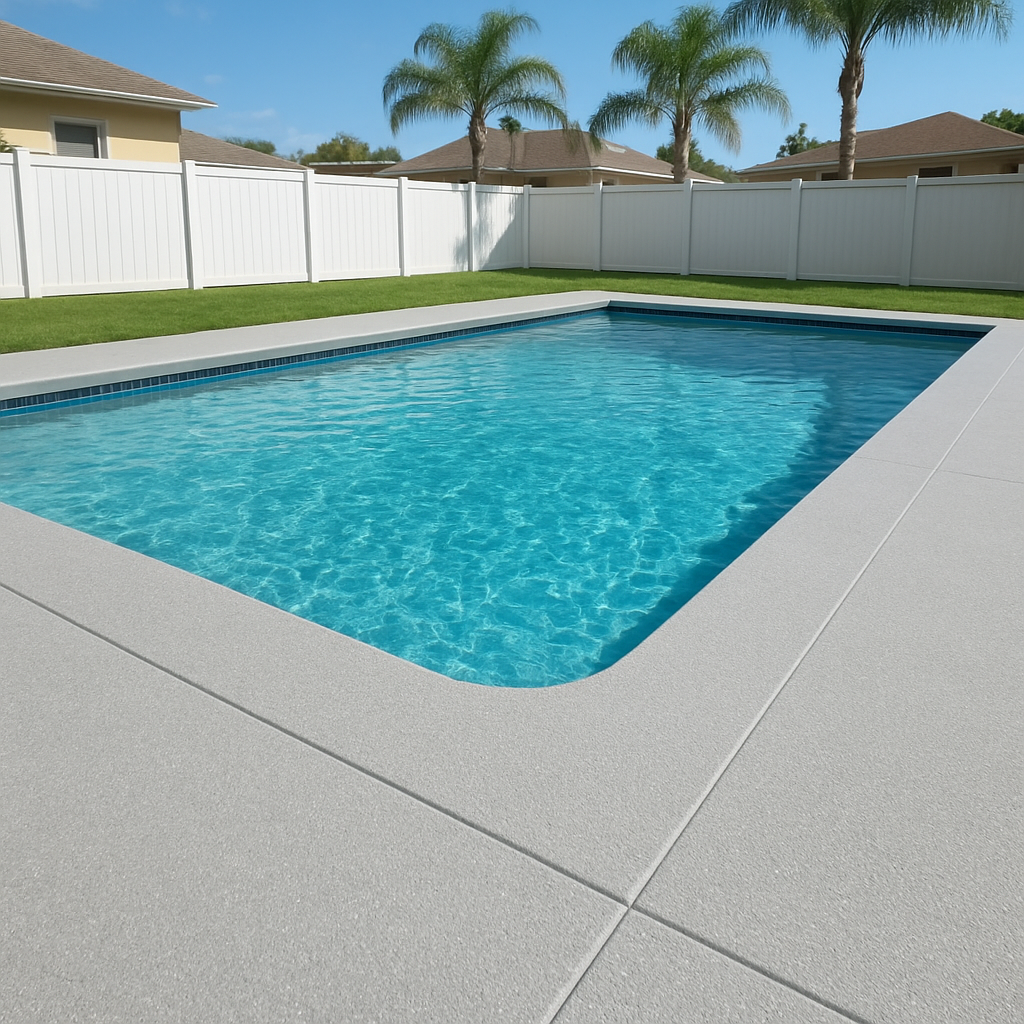
Texture and color choice drive both heat and slip performance more than any other factor.
The Two Things That Actually Decide It
Every one of these systems can be made to look good. What separates them on a pool deck specifically is heat and traction.
Heat is a function of color more than material. Light surfaces reflect; dark surfaces absorb. A dark stamped overlay and a light acrylic coating in the same Lakeland sun are not remotely the same experience barefoot in August.
Traction is a function of texture. Raised or broadcast texture — knockdown, sprayed acrylic, quartz or flake broadcast into resin — keeps grip when wet. Smooth finishes do not, unless a grit additive is deliberately mixed into the sealer. This is the single most common regret with smooth decorative finishes around water.
The Systems, Compared
Roughly ordered from least to most expensive to install.
Acrylic “cool deck” texture coating
A cement-and-acrylic coating sprayed or troweled over the existing slab in a light, textured finish. This is the classic Florida pool deck surface — the category Kool Deck popularised — and it is applied in a thin layer measured in fractions of an inch.
Strengths
- Stays noticeably cooler underfoot than bare gray concrete or dark coatings
- Textured surface provides slip resistance while wet
- Among the least expensive resurfacing systems per square foot
- Light colors reflect rather than absorb Florida sun
Trade-offs
- Thin coating — it renews the surface but does not add structural strength
- Texture holds dirt and needs periodic cleaning
- Typically needs recoating sooner than a thicker overlay
Best for: Decks where heat underfoot and slip resistance matter more than a decorative pattern.
Knockdown texture overlay
A polymer-modified cement overlay sprayed on in droplets, then lightly flattened (“knocked down”) with a trowel to leave a subtle mottled texture. It is the most common decorative pool deck finish in Central Florida.
Strengths
- Good slip resistance from the raised texture
- Accepts integral color and can be scored into patterns
- Thicker than an acrylic coating, so it hides minor surface flaws better
- Cooler than smooth dark surfaces
Trade-offs
- More expensive than a plain acrylic coating
- Texture can feel rough underfoot for some people
- Requires a skilled applicator — the spray-and-knock timing is what makes or breaks the finish
Best for: Homeowners who want a decorative, slip-resistant surface at moderate cost.
Stamped or spray-down concrete overlay
A cement overlay applied over the existing slab and then stamped with texture mats or hand-cut to imitate flagstone, slate, brick, or tile. Color is added with integral pigment, color hardener, and release agents.
Strengths
- Highest-end visual result short of real stone
- Enormous range of patterns and color combinations
- Bonds over the existing slab, so no tear-out is needed
Trade-offs
- Most expensive overlay option
- Smooth stamped areas can be slippery when wet unless a grit additive is used in the sealer
- Dark colors absorb heat — a real consideration for bare feet in Florida
- Needs resealing every few years to keep color from fading
Best for: Decks where appearance is the priority and the budget allows for it.
Micro-topping / skim coat
A very thin polymer-cement coat troweled smooth over the existing surface, usually under 1/8 inch thick. Often used as a clean, modern base that can then be stained or scored.
Strengths
- Smooth, contemporary look
- Thin build height — rarely affects door thresholds or coping heights
- Takes stain and saw-cut patterns well
Trade-offs
- Smooth finish is the most slippery option when wet unless texture or grit is added
- Thin coat telegraphs underlying imperfections more than a knockdown texture
- Not the best choice for a deck that already has visible cracking
Best for: Modern designs where a smooth look is wanted and slip additives are specified.
Polyaspartic / polyurea coatings
Fast-curing resin coating systems, usually installed as a base coat with a broadcast of decorative flake or quartz, sealed with a UV-stable polyaspartic topcoat. This is the resin family actually engineered for exterior use.
Strengths
- UV stable — unlike standard epoxy, it does not amber or chalk in direct sun
- Cures fast, so decks return to service quickly
- Broadcast quartz or flake provides genuine slip resistance
- Very durable against pool chemicals and daily wet traffic
Trade-offs
- Costs more than acrylic or knockdown systems
- Fast cure leaves a short working window — this is not a DIY-friendly system
- Dark or heavily pigmented versions still absorb heat
Best for: Homeowners wanting a hard-wearing resin surface that survives full Florida sun.
Paver or travertine overlay
Thin pavers or travertine tiles laid directly over the existing deck rather than resurfacing it. Technically a covering rather than a resurfacing, but it competes for the same job.
Strengths
- Travertine in particular stays cool underfoot
- Individual units can be lifted and replaced if damaged
- Very long service life
Trade-offs
- Raises the deck height, which can affect coping, door thresholds, and drainage
- Highest cost of the options here
- Joints need periodic sand or grout maintenance
Best for: Decks where the budget allows and the added height is not a problem.
Standard epoxy coating
A two-part thermoset resin coating. Epoxy is the dominant coating for garage floors and interior commercial slabs — but standard epoxy formulations are not UV stable.
Strengths
- Very hard, chemical-resistant film
- Inexpensive relative to other resin systems
- Excellent as a primer or base coat beneath a UV-stable topcoat
Trade-offs
- Ambers, yellows, and chalks under direct sunlight — the central problem outdoors
- Slippery when wet unless anti-slip aggregate is broadcast into it
- Non-breathable film that can blister if moisture moves up through the slab
- Retains heat, especially in darker colors
Best for: Covered or indoor pool rooms, or as a base coat under a polyaspartic topcoat — not as a standalone outdoor surface.
Quick Reference
| If your priority is… | Look at |
|---|---|
| Coolest surface underfoot | Light-colored acrylic cool deck coating; travertine overlay |
| Maximum slip resistance | Knockdown texture overlay; resin with broadcast quartz |
| Best appearance | Stamped or spray-down decorative overlay |
| Lowest install cost | Textured acrylic coating |
| Longest service life | Paver or travertine overlay; polyaspartic system |
| Modern smooth look | Micro-topping — specify a grit additive in the sealer |
| Covered or indoor pool area | Epoxy, or epoxy base with polyaspartic topcoat |
Epoxy comes with enough caveats outdoors that we gave it its own breakdown — Epoxy Pool Deck Resurfacing covers where it genuinely works and what gets used instead. For what each of these runs locally, see the Lakeland cost breakdown.
Pool Deck Costs, Contractors & Guides
See local pricing, compare contractors on the map, or read the full service overview.
More On Pool Deck Resurfacing
The rest of our pool deck guides — costs, surface types, and local providers.
Pool Deck Resurfacing In Lakeland Florida
Local providers, what the work involves, and what it costs around Lakeland.
What Is Concrete Pool Deck Resurfacing?
How resurfacing differs from replacement, and when a deck is a candidate.
How Much Should It Cost To Resurface A Pool Deck In Lakeland Florida?
Per-square-foot pricing, deck-size estimates, and what moves the number.
Epoxy Pool Deck Resurfacing
Where epoxy genuinely fits outdoors — and the UV-stable systems used instead.
5 Pool Deck Renovation Ideas For Your Home
Practical ways to update a tired deck without tearing out the slab.
Frequently Asked Questions
What is the most popular pool deck resurfacing option in Florida?+
Textured acrylic cool deck coatings and knockdown texture overlays dominate in Central Florida. Both are light-colored and textured, which is exactly what a deck needs here — they stay cooler underfoot than bare gray concrete or dark coatings, and the texture keeps grip when the surface is wet.
Which pool deck surface stays coolest?+
Light-colored, textured systems stay coolest — acrylic cool deck coatings were formulated specifically for that purpose, and light knockdown overlays perform similarly. Travertine is also known for staying comparatively cool. Dark colors absorb more heat regardless of which system carries them, so color choice matters as much as material choice.
Which resurfacing option is the least slippery?+
Textured systems: knockdown overlays, textured acrylic coatings, and resin systems with broadcast quartz or flake all provide genuine grip when wet. Smooth finishes — micro-toppings and smooth stamped areas — are the most slippery and need a grit additive mixed into the sealer to be safe around a pool.
Can you use epoxy on an outdoor pool deck?+
Standard epoxy is not UV stable, so it ambers, yellows, and chalks in direct sunlight. That makes it a poor standalone choice for an outdoor Florida pool deck. Epoxy does work well as a primer or base coat underneath a UV-stable polyaspartic topcoat, and it is genuinely appropriate for covered or indoor pool areas.
Which pool deck resurfacing option lasts the longest?+
Paver and travertine overlays have the longest service life since they are solid units rather than a coating, followed by polyaspartic systems and thicker stamped overlays. Thin acrylic coatings sit at the other end — they are the least expensive to install and the soonest to need recoating.
Do I have to remove the old surface before resurfacing?+
Not usually, but it has to be properly prepared. Most systems bond over an existing sound surface after pressure washing and mechanical grinding or acid etching. Old coatings that are peeling or delaminating do need to come off first, because a new layer bonded to a failing one will fail with it.
Get a Free Pool Deck Quote
Submit a free quote request and we'll connect you with a Lakeland contractor who resurfaces pool decks — no waiting on a callback.